

08 Jan Why Operational Losses Matter More Than Marketing in eCommerce
Most eCommerce teams instinctively focus on growth. More traffic, better ads, higher conversion rates — these metrics dominate dashboards and meetings. Growth feels tangible and exciting. Losses, on the other hand, are quieter. They don’t announce themselves loudly, but they compound steadily in the background.
For many online businesses, especially those operating in high-COD or logistics-heavy markets, operational losses quietly erase profits long before marketing efforts fail.
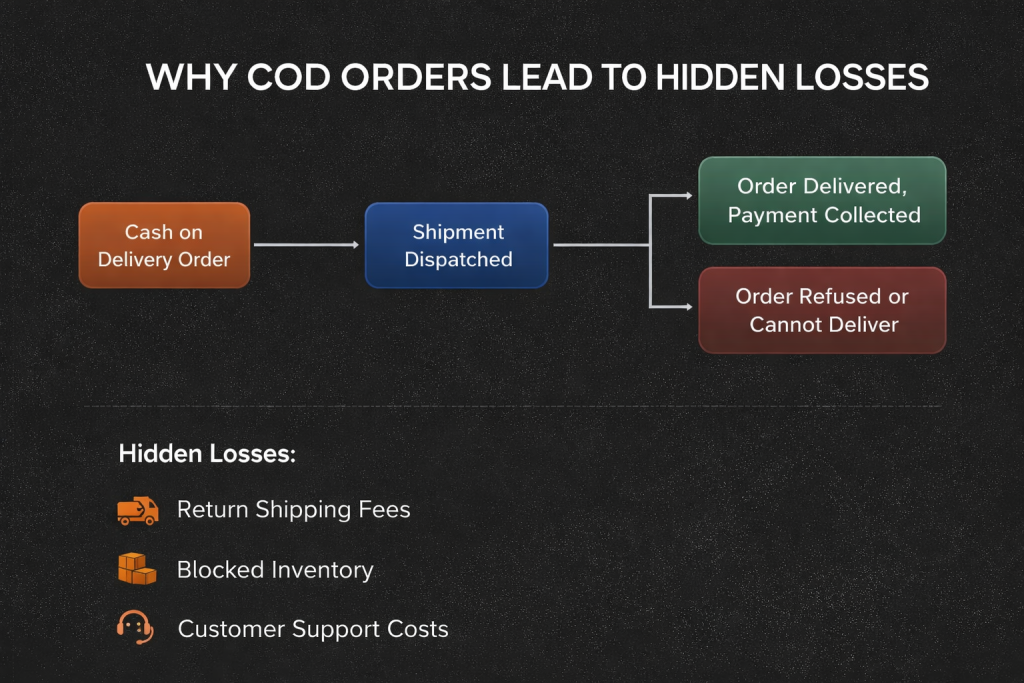
Growth Without Control Is a Leaky Bucket
Scaling marketing without operational safeguards is like pouring water into a leaking bucket. The more aggressively you pour, the faster the water escapes.
As order volume increases, so do the hidden costs: shipping fees for undelivered orders, reverse logistics expenses, warehouse handling overhead, and customer support effort. On paper, revenue appears to grow. In reality, realization often doesn’t keep pace.
This is why many stores experience the paradox of increasing sales but declining profitability.
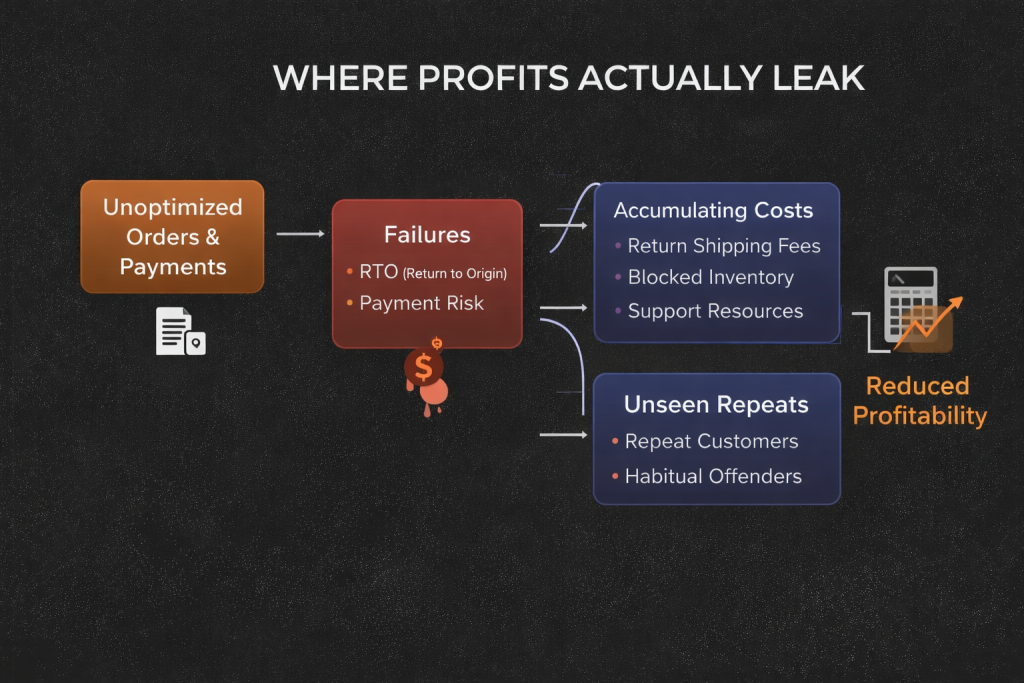
Where Profits Actually Leak
Operational losses are rarely caused by one catastrophic failure. They emerge from repeated, predictable patterns.
Return-to-origin orders are a prime example. Each failed delivery incurs forward and return shipping costs, blocks inventory, and consumes operational bandwidth. Over time, these costs accumulate silently.
Another major contributor is payment risk. Certain payment methods and customer behaviors consistently correlate with higher failure rates. Treating all orders equally ignores valuable signals that could have prevented loss before shipment.
Then there are repeat offenders — customers who habitually refuse deliveries or exploit policies. Without historical enforcement, these patterns remain invisible and continue to drain margins.
Why Marketing Alone Cannot Fix This
Marketing optimizes acquisition. It does not optimize realization.
No campaign, however well-targeted, can prevent losses that occur after checkout. When operational risk is unmanaged, higher traffic simply amplifies inefficiency. Every new order increases exposure rather than profitability.
This is why many fast-growing stores end up firefighting instead of scaling. They are busy reacting to problems that should have been prevented earlier in the funnel.
The ROI of Operational Controls
Unlike marketing experiments that require weeks of data to validate, operational improvements often show impact almost immediately.
When high-risk orders are filtered at checkout, logistics waste drops. When repeat offenders are restricted, support overhead decreases. When payment rules adapt to context, margins stabilize.
These gains compound over time. Every future order benefits from better decisions made upstream.
Control Doesn’t Mean Friction
A common misconception is that risk controls harm conversion rates. In practice, poor controls hurt experience — intelligent controls do not.
Well-designed systems operate selectively. They consider order value, customer history, geography, and behavior. Instead of blanket restrictions, they apply precision. The result is fewer losses without penalizing genuine customers.
Secure Operations Before You Scale
Sustainable growth is built on controlled operations. The most resilient eCommerce businesses reduce predictable losses first, then scale confidently.
Marketing brings traffic. Operational discipline turns traffic into profit.
Take the First Step
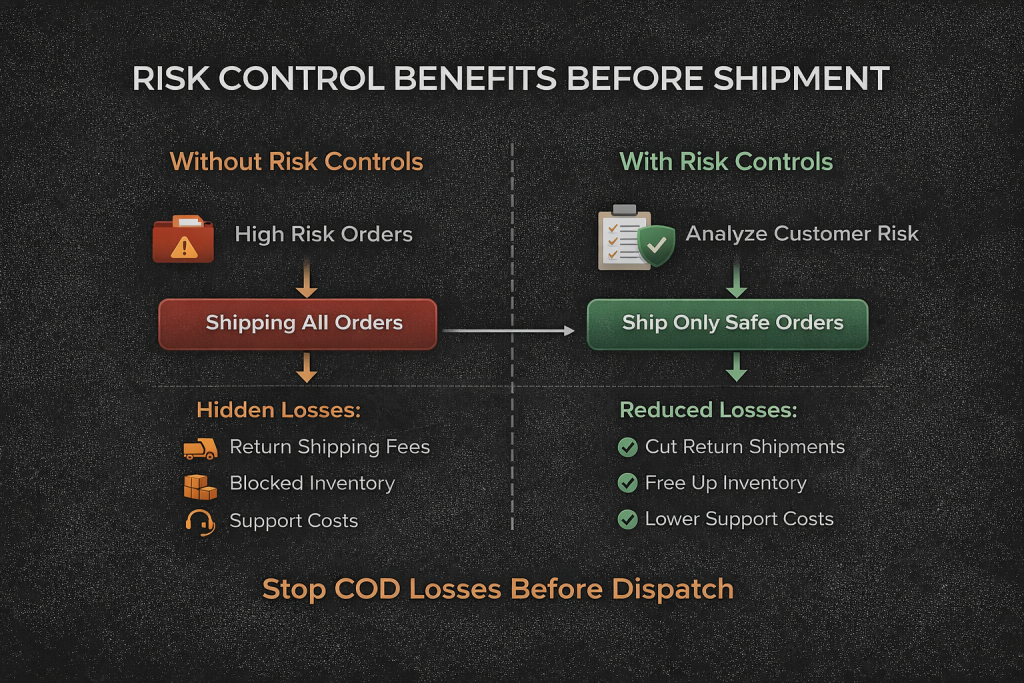
Shivyn focuses on preventing operational losses before they occur — starting at checkout, where decisions matter most.
Explore COD RTO Control for Magento and build growth on a stable foundation.
Sorry, the comment form is closed at this time.